Wednesday, January 6, 2010

My plans for the 2010 global reading challenge

I have realized belatedly, that, having linked to the 2010 Global Reading Challenge, I ought to make a brief list of my intentions to fulfill it.

Doing the easy challenge as I am, it's going to be a pretty short list, and very subject to change:

South America:
I think this has got to be Roberto Bolaño's The Savage Detectives.

North America:
I think this will have to be Canadian rather than from the U.S., for the sake of expansion. Luckily, I think I've suddenly thought of just the one--Michel Basilières and his novel, Black Bird, recommended by Canadian crimewriter John McFetridge.

Europe:
I decided to avoid England, Ireland and Scandinavia for this challenge, as I seem to do quite well finding books without prompting in these countries. It looks like the book is going to be French writer Fred Vargas' This Night's Foul Work, for the simple reason that I have already started to read it.

Australasia:
Not sure on this one. I'm leaning toward finally reading Peter Temple's Broken Shore.

Asia:
I'm thinking of breaking outside of the crime box and reading Vikram Seth's Suitable Boy for this one.

Africa:
I'm pretty sure I'll go for Deon Meyer's Dead Before Dying.

One book at a time, though. One book at a time.

Friday, January 1, 2010

Dorte's 2010 Global Reading Challenge

I just realized that this is as good a place as any to make mention of Dorte Jakobsen's 2010 Global Reading Challenge, which is basically a challenge to broaden your reading a bit in the new year.Take the easy, medium or expert challenge, and then plunge right in and read books from all over the world. The idea is to review them on your blog or website or whatever as you go, but if that sounds intimidating, just remember that a review can be as simple as "I liked it".

A lot of the folks doing the challenge will be reading crime fiction, but don't feel limited to that if it's not your thing. I probably won't be sticking to that myself.

At first I thought it was just the challenge itself that was intriguing, but what will really be intriguing is the accumulation of reviews and recommendations.

What are you waiting for? Hop on over and have a look.

Sunday, December 27, 2009

The Wrong Mother, by Sophie Hannah


I've been hearing about Sophie Hannah from a couple of different directions lately--first, hot ticket novelist Tana French has mentioned recently that she is on French's own shortlist, and secondly, Martin Edwards has written a good piece on her over on his blog, Do You Write Under Your Own Name?. Then Penguin was kind enough to send me an unsolicited copy of The Wrong Mother and I was off and running.

I am not going to delve into the twists and turns of this complex and very absorbing crime novel, other than to say that it starts off in the voice of a mother of young children who has an upsetting encounter with her child minder, and not too long after, finds herself pushed into the path of a bus, apparently deliberately. What I will say is that it is no accident that the novel starts off with a dilemma about childcare, career and the mothering of young children. There is not just one mother facing this situation of trying to be a good mother and still holding on to an interesting career despite the demands, there are several.

In fact, you might say that The Wrong Mother is an exercise in refracting the same basic situation through several different lenses. The care of self versus the love of one's children plays out in various ways. One question that I was left with was more general, though. When we complain about the people and situations in our lives, how seriously do we mean this and how seriously do we expect others to take us?

Although ultimately I found some of the resolution of this story a little unsatisfying, it does fit within the conventions of crime fiction, and I have to say that I was reading compulsively all the way through and the main puzzle of the story was not one I saw through till quite close to the end. I'm eager to read more of Hannah's work, and though I think mothers with small children would find much to relate to here, I am not sure they could read this book with equanimity.

Friday, December 11, 2009

Ordinary Thunderstorms by William Boyd


I must admit a weakness for novels that use London as a strong and evocative setting. Vikram Seth's An Equal Music springs to mind as do several of the mysteries of P.D. James, maybe particularly Original Sin with it's venerable London publishing house set right on the Thames. I recall reading her early novel, Innocent Blood, before I ever visited the city, and I do know that a young woman being able to find a flat in London seemed one of the most glamorous things in the world--and this before I had the faintest idea of London prices.

William Boyd's Ordinary Thunderstorms joins the ranks of those crime novels that use both London and the Thames to great effect. Here's the opening:

Let us start with the river--all things begin with the river, and we shall probably end there, no doubt--but let's wait and see how we go. Soon, in a minute or two, a young man will come and stand by the river's edge, here at Chelsea Bridge, in London.

And of course that was enough to hook me right in. I will not give away whether things do or do not end at the river, but the river is very much a part of the landscape through much of the book. It reveals itself in different aspects to different people, reflecting their inner lives as well as outer weather.

A chance encounter leads our hero, Adam Kindred, to become deeply implicated in a crime. His own decisions in response to this lead him further afield, until he finds himself looking at London from the lower strata, a view of the city that few tourists get to see. Meanwhile, there are some pretty major corporate shenanigans going on, and of course someone who's been sent to clean up untidy loose ends like, say, witnesses. Although at times this seems fairly standard stuff, the pacing keeps it lively.

What I find more interesting, and what I think most readers will, is not just the way Adam hides out in a vast and in many ways impersonal city, but the way in which he comes to accept that riding the river of chance, and being able to let go of the old life as necessary, is really all we have. There's a clever, ironic twist when another character has to make the same decision, but I'll leave that to you to find.

As it turns out, there are more than a few people in this book hiding from what they once were. But, as is pointed out in the novel, 600 people are reported missing in Britain every week. That a few of their fictional counterparts find their way between these pages does not in the end seem too improbable.

Friday, December 4, 2009

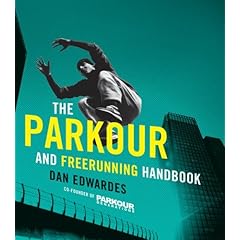
The Parkour and Freerunning Handbook, by Dan Edwardes

Every once in awhile, this blog must be forgiven if it takes a break from writing up books of a high literary character and indulges in its author's odd private obsessions. This post is one of them.

What are parkour and freerunning? Well, fans of the recent film Casino Royale are probably already familiar with the opening sequence that made this gymnastic way of moving through the urban landscape famous. For those who haven't seen the film, you can think of this as a whole new way of getting around and relating to your city or town.

Okay--I am not really the ideal candidate to practice this discipline. I don't think I'll be doing backflips off three story buildings any time soon, for instance. But of course the primal place for all of us is always our imagination, and whether we can practice this in the urban landscape itself, or only in the far frontiers of our imaginations, this stuff is really cool. It's a shift in our thinking about city streets, city railings and city buildings to imagine owning these impersonal public structures with our personal stunts and feats. If you're young and athletic, you may be able to duplicate some of the moves demonstrated in this book. But even if you're not, and I believe this is actually the important part, you too can imagine the streets you live on in an entirely new way. Take a look at this book, or the movie Casino Royale for that matter, and try to picture yourself doing such stunts on the streets where you live. You will inhabit your own space on earth in an entirely new way if you do.

Tuesday, November 10, 2009

The Dead Yard, by Adrian McKinty

I have just recently finished reading the Dead trilogy, with Belfast's Michael Forsythe as hero or anti-hero or something. I wouldn't recommend reading the series in the order I have, but as the first is out of print in the U.S. right now, do what you must.

The Dead Yard is the second book in the series, although chronologically, this story actually fits in somewhere before the coda at the end of the first novel, Dead I Well May Be. Starting off on the island Spanish island of Tenerife, somewhere off the east coast of Africa, the action swiftly moves back to the east coast of America, which is a different clime entirely.

It doesn't give too much away, I think, to reveal that Michael becomes embedded in a disaffected Irish group who are hoping to make a big splash to gain favor back in the home country.

I've heard that some find this middle novel darker than the others, but frankly I'm surprised at that. Our introduction to Michael Forsythe in Dead I Well May Be very quickly throws us into the dark and violent world he lives in, and shows him to be if not a willing participant, at least a compliant and resigned one.

As a person who is not particularly drawn to violence as a selling point, I have had to think a bit about why this series works for me. True, the writing is tight and at times gorgeous, and the darkness of the series is relieved by the author's periodic wit. Still, we are left with the conundrum of the appeal of the central character. I must admit that I was a bit baffled by it, especially in reading this second, but for me, third of this very compelling series.

And then I thought of Odysseus.

Now let me say right out front that at its heart,this is an action series. If you liked Matt Damon in the Jason Bourne movies, then you should be saying your prayers that someone in Hollywood will see the commercial potential of this series. But it remains true that these books are more literary at their roots and so the Odysseus reference seems fair.

Michael Forsythe starts in Belfast, and though this may be a spoiler, ends in Belfast. He does, in effect, live out his own odyssey, and spends his time in various lands with various snares, just as Odysseus does. Although the third book, The Bloomsday Dead, actually models itself on the plan of Joyce's Ulysses, which in turn is also based on The Odyssey, I don't mean to imply that this is a deliberate pattern of the books. But I will say that thinking about the character of Odysseus may prove helpful in thinking about the character of Michael Forsythe. Because the chief word that springs to mind for both characters is "cunning". Not kind, not compassionate, although both characters do at times exhibit these traits, but cunning. Like Odysseus, Michael Forsythe makes survival his highest value. Odysseus does this because he intends to return home, no matter the pain, and no matter the cost. Forsythe never makes this goal plain, even to himself, but in fact, there is a Penelope, though not as Penelope ever imagined herself, and there is even a Telemachus of sorts, though the less I say about that the better.

I believe that Odysseus is a type of human consciousness and Michael Forsythe is a reflection of that type. Although we see Odysseus in a heroic light, Forsythe casts a different sort of light. In a way, he shows the limits of the heroic mold. Odysseus survives by embodying the heroic values of courage, resourcefulness, foresight, and yes, cunning. So does Michael. But in these, our latter times, the ending is not so neat. Michael Forsythe, at the end of the day, is not a Hero, but a human being. And human beings carry within them the history of all their actions--an anti-heroic tale indeed.

Sunday, October 25, 2009

All the Little Live Things, by Wallace Stegner

I have only a few minutes to revive a practice I kind of like which is to put in a word about the book that will shortly be under discussion at tonight's book group. Still let's give it a go.

Wallace Stegner published this book in 1967, and the story of Joe and Ruth Allston, in supposed retreat in what is presumably the Santa Cruz Mountains is a perfect picture of that historical moment, and of that geographical locality. Reminiscent of Andre Dubus II's The House of Sand and Fog, though strictly speaking, chronologically the reverse is true, as a portrait of a small cast of characters engaged in a conflict of types in a very individuated setting, it left me very nostalgic for an era close to me in time but which I was too late to participate in. As in Dubus' book, the conflict between different types of people escalates to logical if possibly greater than life conclusions.

Stegner taught a prestigious writing program at Stanford until shortly before he died, and his son Page taught at my own UC Santa Cruz; and his wife has had some success as a novelist in her own right. It is tempting to search for autobiographical elements, but the book is none the worse if you don't have any of these more personal connections.

To be continued...


...I'd hoped to post the group's responses a little earlier than this, while they were still fresh in my memory, but time has gotten away from me. I'm happy to report that this was the rare book that all our members seemed to enjoy, and probably for roughly the same reasons. The craftsmanship of the novel is very evident without calling attention to itself, and this appealed particularly for whom technical skill is one of the primary considerations. Stegner's gift for rendering setting and making it part of the plot itself was probably the thing we most appreciated as a group, and that is largely because we live in the area just south of where Stegner places it, and its natural elements are second nature to us. In other words, it made us savor our place in time and geography.

We are all old enough to have lived during the sixties, and some to have actually participated in that turbulent era. The fact is that the sixties are very much still alive in Santa Cruz, where we live, and the conflict between the hardened older man and the naive but somewhat arrogant younger one who worms his way into the narrator's life is something we face as a community as much as individually. Many Jim Pecks of our own day have made the downtown streets of Santa Cruz their home, and pose a similar problem for the upstanding citizenry as Jim Peck did for Joe Allston. Collectively, we find them an affront and yet no one quite has the heart or the good enough excuse to kick them off the land, which was Allston's dilemma as well. If I sometimes sense that one 'incident' would be all it would take to send them all packing, this also parallels the novel.

I tried out the point that none of us would probably like the saintly Marian much if we actually had to live with her, but the group didn't really buy that. I'm not sure I buy it myself. In some ways she is a model of what we should be. But it's interesting to note that she was certainly as naive as Jim Peck was, though all her faults are excused and all of his are excoriated. To me she remains to some extent a person whose philosophy not only won out over her own common sense but bent other people to her will as well, against their own best and probably better judgement.

No, I must stand by my own view of things.I probably wouldn't have liked her.