Sunday, May 16, 2010

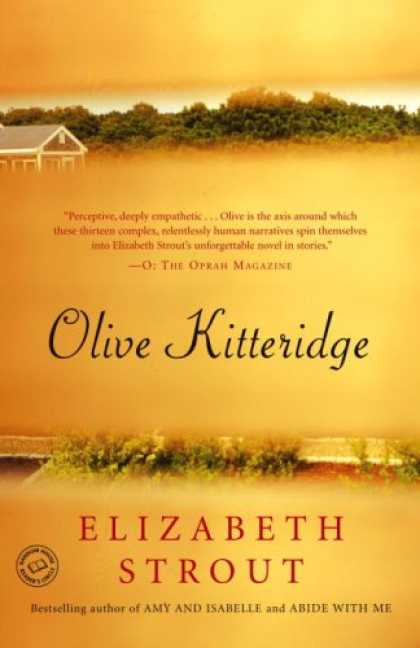
Olive Kitteridge by Elizabeth Strout

Our May reading group pick. Winner of last year's Pulitizer prize, this has been selected for discussion by a lot of reading groups since, making me think of it as a kind of quintessential reading group book, the qualities of which I've been mulling over quite a bit as I've been reading.

As is a fairly common device these days, this novel is actually a series of linked stories, much like Sherwood Anderson's Winesburg,Ohio. In fact, it could as aptly have been titled "Crosby, Maine", as in all but one instance, the town and its environs are as much a character as Olive is, if not more so. In a few stories her actual presence is so slight that she merely makes an appearance at some sort of gathering the protagonist is attending. It cannot be said that these cameos actually add anything to the story they appear in or further our understanding of Olive herself, although they do often reinforce the sense of her formidability as a teacher. What they do serve to do is make Olive serve as a kind of glue for the book as a whole, though personally, I think it might have been a bit more intriguing to just leave her out of several stories all together. If, as seems likely, Olive and the town of Crosby are emanations of the same spirit, it is not really all that necessary to dot all your  "i"s and cross all your "t"s in quite this manner.

If you look over on a site like Good Reads, you will find that a great number of people have found this book to be worth a five star rating, and I've read a few commenters that call it life-changing or confess having been deeply moved by it. These kinds of testimonies have their own authority, I think. You can't just say, "you are wrong" to readers who have had this kind of experience. There are, however, a few reviews mixed in of what I would call the "Bleh!" variety. I find myself somewhere in the middle of this spectrum, and somewhat at odds with myself in my own response to the novel.

The truth is, I had no trouble reading this book. I enjoyed the stories, found them seamless in the telling, although as they are actually stories collected from over a long span of time, it's not surprising that there is some repetitiveness in the detail. I have heard a few people say that they do not care for Olive herself, and apart from the fact that the likeableness of a main character is not something I think an author is required to give, I did actually like her in all her ornariness.

Nor do I think the stories forgettable. I think some of them will stay with me for a long time, in fact. So what really is my bone to pick with this book? Why do I insist on having any bone to pick with it at all? I think it's because the stories of quiet, ordinary, lonely, sometimes desperate lives has about run it's course with me. Perhaps my resistance is so great because they remind me too much of a certain type of story I have written myself. (I'm not comparing the success of our different attempts at this, merely our subject matter.) But whatever the reason, more than once while reading this collection, I have thought, Where the hell is Charles Dickens when we need him? Where is the larger than life, outrageous character? And where is the writer who is going to tell me that life is about something more than I've figured out already?

Of course, it's unfair to make this demand of a book that never had any intention of being, say, Great Expectations. What I do think, though, is that when you award a Pulitzer to a book like this, you are setting a standard for what contemporary fiction should strive to be. And I'm finding more and more that I beg to differ to with that idea of success. As I believe I said in my own quick take in my Good Reads review, "wry" and "quietly absorbing" no longer seem to be quite enough for me.

I am not sure just what is.

Friday, May 7, 2010

Charlotte, Emily and Anne


While we all wait around for me to get my act together and post a new review of something, we could do worse than to check out this cool comic by Kate Beaton, entitled Dude Watchin' With the Brontes.

This came to me by way of a great website called Chicklit forums, which is not really about Chicklit at all, nor is it just for chicks. Yeah, it's a long story.

Sunday, April 18, 2010

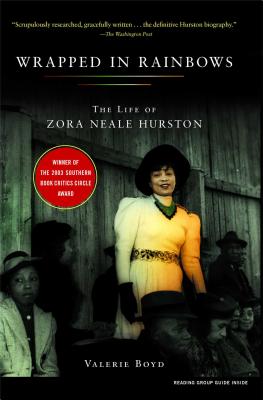
Wrapped in Rainbows: The Life of Zora Neale Hurston, by Valerie Boyd

I've lately been reading quite a bit by and about the writer Zora Neale Hurston for a rather mad project I've embarked on, and reading this book was probably my deepest venture yet into the story of her life. I have also read Hurston's own account, Dust Tracks on the Road, which has its strengths, but this only takes us so far, as there are certain things Hurston would like to pass over--and have us pass over as well. Also, as with all autobiography, it ends before the story is over, and in this case, quite a bit before it is over,  as Hurston was pressured by her publisher to attempt her memoir before she herself felt ready to do it. And still, we are lucky to have it.

I thought it might help me, if no one else, to gather some of my thoughts about Boyd's longer account. Although Hurston's trajectory through life is too unique and in some ways extraordinary to be much of a model for anyone else, from her birth and early life in an all black community in late 19th century and early 20th Florida, to her initiations into hoodoo and then voodoo, her life as a writer bears some common themes with the life of many other writers, and in that sense, though fraught with crisis and complexity, might make a person feel not so alone on that particular path.

One thing that seems very common to me is the struggle with vocation, with its companion theme of the struggle to discover one's material. I suppose there are people who have a kind of certitude about their gifts, but Hurston's relation to her own writerly gifts seems much more common. Her first desire was simply for education and to see some of the world. Few people who might happen upon this post will have faced anything like the kind of obstacles that lay before her. And with a gap of years in her life which she never spoke about, and which, to my knowledge, we have no remaining record of, we will probably never know all that she lived through before she became a writer and personality to be reckoned with.

As someone who lived at the center of the Harlem Renaissance, while at the same time attending the elite Barnard college, the first black woman to do so, it's understandable that she might have a little trouble fitting herself into typical roles. She tried to make the sensible decision of becoming an anthropologist and succeeded in this, though in an unconventional way. In this process, she added a lot to to what we know, both about African-American life in the American South of her era, and about that of the Bahamas, Haiti and the Dominican Republic. But though her books are an addition to our knowledge, a close reading of them reveals the stance of an artist and not a scientist. She doesn't always achieve the scientist's detached viewpoint, although I think her own 'semi-detached' viewpoint is instructive just in itself. I will hazard a guess that her anthropological works like Tell My Horse, and Of Men and Mules are really books by a novelist looking for her material. It's instructive, for instance, that it was while she ostensibly went on a trip to Haiti to understand the culture of voodoo, which, by the way, she treats with immense respect and becomes an initiate in, she also wrote Their Eyes Were Watching God--to my mind, one of the great American novels of the last century--in seven short weeks, apparently in her spare time.

The other aspect of her life that seems relevant to today's writers, and perhaps to writers at all times everywhere, is the utter contingency of her situation. Put more plainly, she was always scraping around for money--not because she lived an extravagant lifestyle, though she was generous with money, but because that is a writer's life, when not cushioned by a reliable job, a trust fund or something else more steady and predictable. She did try to find something like this--it's just that she never really managed it. There are some writers who can find or at least luck into one of these things, but I think the thing that struck me about Valerie Boyd's account is the idea that at root, Hurston's life is any artist's life. For the great majority of writers, and that doesn't by any means exclude the geniuses, there are plottings and negotiations, and maybe even a bit of kissing up, doing hack work and so on. People let you down. People have expectations that don't actually match up with what you are called to do. Even success doesn't provide future security. Hurston died in poverty. She was buried in an unmarked grave. (Which Alice Walker famously tracked down and bought a headstone for, so don't toss and turn at night about that part.)

When you are keyed into a life, for whatever reason, the biographer of that life holds a special place in your heart. So I would like to take this opportunity to thank Valerie Boyd for her steady, calm, exhaustive and highly readable research into the life of a singular American author. I am sure that with such an extraodinary energy at the center of her field of enquiry, it wasn't always easy.  

Thursday, April 8, 2010

Tell My Horse, by Zora Neale Hurston

I'm very absorbed in the life of Zora Neale Hurston these days. Coincidentally, this book on Hurston's travels to Jamaica and Haiti was a book group choice, based on a group desire to learn a little more about Haiti in the aftermath of this year's devastating Haitian earthquake. Although for me, Hurston's Their Eyes Were Watching God remains the benchmark, this book proves how engaging a writer Hurston is in more ordinary circumstances. (Though how I can use "ordinary" in a description of a book that includes wild boar hunts and zombies, I don't know.)

Hurston is known most famously as a novelist, but she also studied anthropology under Franz Boas, and spent countless hours collecting African-American folklore throughout the south. Her journey to the Caribbean was of an anthropological nature as well. What remains interesting are her intent to keep her findings accessible to the general public and her viewpoint, which was detached without being remote, and treated the cultures she studied with an uncondescending respect.

"Tell My Horse" or parlay cheval ou in Creole, refers to the time when a person is 'mounted' by the spirit or loa, Guede. Possession or assumed possession by the loa gives the person a kind of permission to speak in the voice of the god, often saying things that he or she would not dare to say in real life. It reminds me a bit of the tradition of the Holy Fool in Russian Orthodox Christianity. I hadn't thought till now that Hurston's choice of this title may be telling.

Although the book is not the tightest she ever wrote, it is full of fascination. The fact that fascinates me the most, though, is one that doesn't appear in it. While Hurston was in Haiti--"after hours" so to speak--she sat down and wrote Their Eyes Were Watching God in six short weeks. Personally, I consider the novel one of the great books of the twentieth century. Hurston wrote it so quickly and mentioned so little about the travails of doing so, it makes me wonder if she had any idea of what a gift she bestowed upon us.

I hope so.

Saturday, March 13, 2010

J is For Judgment--or one good reason to read mystery novels.


This blog has lagged a bit of late. The main reason is that with multiple projects going, I don't seem to be getting done with any of them. For example, I'm a fair way into this tenth outing of Sue Grafton's Kinsey Milhone series but that's not the same as done. Luckily for me, with mysteries, you shouldn't give too much away anyway. So, though I have at least gotten a bit further than this, here is a little quotation from pages 8 and 9 in the mass market edition:

"Wendell Jaffe and his partner, Carl Eckert, put together limited partnerships for real estate deals to develop raw land, build condominiums, office buildings, shopping centers, that kind of thing. They were promising investors a fifteen percent return, plus a return of their original investment within four years before the two partners would take a profit. Of course, they got in way over their heads, taking off big fees, paying huge 'overhead' expenses, rewarding themselves handsomely.

Alarm bells, anyone? No? Very well then, I'll continue:

When profits failed to materialize, they ended up paying old investors with the new investor's money, shifting cash from one shell company to the next, constantly soliciting new money to keep the game afloat."

"In other words, a Ponzi scheme," I inserted.

"Right. I think they started with good intentions, but that's how it ended up..."


And yes, this absolutely reeks of the whole Madoff scandal. There's just one slight problem. This was first published in 1993.

Sometimes people put down reading mysteries and crime fiction as a waste of time. But if a few more people had read these lines back in the nineties, they might have a bit more retirement money in the bank than they do now. Sadly.

Monday, February 8, 2010

This Night's Foul Work by Fred Vargas


This book will be the first reviewed for the 2010 Global Reading Challenge, set by Dorte Jakobsen. (Thanks, Dorte!)

I have to admit that the cover did not inspire me to read this one and in fact I would not have opened it if I hadn't heard good things about it over time, and if I hadn't set myself a small goal of tackling some of my shelf-sitters. The title is actually a tribute to the French poet Racine, who figures prominently in the book, due to one character's intimate familiarity with his style. The French title is actually quite different--Dans les bois éternels , which translates to something more along the lines of "In the eternal woods". I don't know if that would have drawn me in any faster, but at least it would be unlikely to have the picture of a dead stag on the cover.


Anyway, neither the author's name, nor the title, nor yet the cover image clued me in to the fact that this novel is in fact a Parisian police procedural, and a very delightful one at that. Vargas' detective squad is the closest I have come to the classic Amsterdam based Grijpstra and de Gier series of Janwillem van de Wetering. Led by the Commissaire Jean-Baptiste Adamsberg, a right-brained dreamer if ever there was one, the Paris Crime Squad holds as many idiosyncratic characters as anyone could ask for. This book comes fairly late in the series, but Vargas does a good job at delineating the characters again for new readers like me.

I fear that certain kinds of readers will throw up their hands at many of the more absurd situations and improbable plot twists in this one. But for readers who are willing to surrender and enjoy the ride there are many rewards. It's extremely well plotted and woven together, and the twists and turns of the central mystery, as well as a secondary one involving Adamsberg's past kept me guessing.

One of the great pleasures of Vargas' work is the way she describes all the detectives--with the exception perhaps of the formidable Retancourt, a woman of many talents--as flawed and somewhat hapless in their own lives, but how in collaboration their strengths come to the fore.

I do have a small problem with the translation, which is that whenever the story ventures into the realm of dialect, the translator's efforts to find some substitute in English slang fall flat. It's a shame, because her rendering of the speech of Adamsberg and the detective squad is subtlety itself.

I found that at the end of reading this one, and despite many other goals, I wanted to nothing so much as begin reading another. And so I have...

Monday, February 1, 2010

Winterland by Alan Glynn


I was tempted to throw in an imaginary subtitle: The Lost Language of Cranes, but that was already taken. Anyone who visited Ireland four or five years ago, as I did, could not have failed to get the reference. There were cranes everywhere--new schemes, new money, even all new people (another stolen literary reference). Attractive young Irish people flocked the streets in expensive new clothes--never have I felt so old and past the moment--and the small hotels and bars and pretty much everywhere were staffed by Asians and Eastern Europeans, most of whom did not seem at all happy.

That moment, for better or worse, is done--at least for the time being. Capital, and labor, has come and fled again, as it has so many other places. This is the setting of Alan Glynn's excellent new novel Winterland.

The initial setup is this: a young thug, Noel Rafferty, is murdered at a local pub. As he is revealed from the outset to be a very unpleasant character, we do not mourn him much. But his tightly knit Dublin family does, of course, and their grief is more than doubled when his uncle, his namesake, dies in a car accident that very night. Tragic coincidence, yes, but their common relative Gina Rafferty begins to doubt that all is exactly as it seems. Gina's company, a start-up, is having troubles in the new economic climate. And it's not the only thing that's suffering in the fallout of global recession.

I love the way the local and the global overlap and affect each other in this novel. I also love the acute depiction of the way government and business and law enforcement are all in each other's pockets. Gina Rafferty is a great and fearless character in this setting. Here's hoping we hear a bit more from her in the future.