Monday, November 21, 2011

The Cold Cold Ground--a teaser


Adrian McKinty's The Cold Cold Ground is coming out in January. Even so, you're not going to be able to buy this in the U.S. just then. If you want it, you can preorder it from BookDepository.com or Serpent's Tail, or, if you must, Amazon.co.uk .

But as of today, you can read a sneak preview of the opening. Go take a look, then come back here. I sense diminishing returns here but never mind--it's fine if you stay over on that excellent blog instead. Feel free to comment. He won't bite. At least, he's in Australia, so if you're on another continent, you're pretty safe...

***

So did you check it out? I think this opening is trademark McKinty. It's a synecdoche of the book as a whole, and perhaps of McKinty's work in general. You have the  compact poetry of the language, the violence of the scene observed, the casually thrown off cultural references from many levels, the diligent attention to factual detail, the dark humor, and the absolute refusal to bow down before anybody's sacred cows.

I have read the book in manuscript form and if you liked that sample, it only gets better from there. I'll review the book when I actually read it in published form.

Sunday, November 6, 2011

Confessions of an Economic Hitman, by John Perkins

Another one that I've wrapped up recently. I was actually reading this for a project I'm doing. I was expecting it to be a bit more cloak and dagger than it actually is. Basically, Perkins is trying to atone for a career in which by slanting economic data in certain directions, he and the people he worked with were able to convince the right people in various nations of the world that they should throw in there lot with U.S. and corporate interests. Then general effect of these projects seems to have been to build a lot of infrastructure in these countries which the countries in the end couldn't pay for, making them coercible and more amenable to our, and I use that word with a bit of hesitation, agenda.

Perkins met more than a few of the major players during his time in the game, and his talks with people who went against this agenda are valuable in and of themselves. He had a conversation with the popular General Torrijos before he died in a plane crash, as well as a chance encounter with Graham Greene, who was a friend of Torrijos.

I thought Perkins put his thesis together in a readable and accessible way, though I found myself wanting to read a critique of his book, as I'm a bit out of my depth judging it myself. Nevertheless, it does give you a lens to view the world, and some things that I didn't really understand before at least fit into place in this picture.

A couple of things that have struck me since because of this book. First, I was listening to something about Iraq as the U.S. 'wraps things up there' and they were saying something about access to Iraqi oil. Now of  course I've long heard about this idea that we went into Iraq only for the oil, but after reading Perkins book, I suddenly saw something inexorable about this process, and that an eight or nine year war costing thousands of lives and incredible expense is really just a hiccup in this process of attaining access to that oil. I don't even attribute to a U.S. policy or any nation's agenda so much as to a kind of mindless machine, or as Perkins calls it, the "corporatocracy".

I also just happened to watch the beginning of Reilly: Ace of Spies last night and it turned out that Reilly's first mission in Baku, which was part of Russia at the time, but was before and since a major city of Azerbaijan, was really to collect information on oil.

That was 1901.

Perkins just happens to be coming to town at the end of this week, and I'm going to do my best to hear what he has to say about present developments.

Thursday, November 3, 2011

Don't Look Now, by Daphne DuMaurier

I finished this book a few days ago. It was another one I read for the Good Reads discussion group. We knew of the creepy nature of some of DuMaurier's stories, so thought it would it be a good pick for spooky October. I think we all pretty much enjoyed it. It was a bit longer than some of our other choices, and perhaps a tad more uneven. The first tale in the book, the title piece 'Don't Look Now', was made into a Nicholas Roeg movie that you may have seen--I'll definitely be renting it at some point, as others in the group seemed to have thought it was good and faithful to the story.

Another filmmaker seemed to have diverged a bit more, and not to DuMaurier's liking. Alfred Hitchcock's 'The Birds' was taken from DuMaurier's tale of the same name, but he shifted a few things, including the locale, and perhaps even the larger meaning. It's easy to understand why it might irritate her, but I thought that the deeper tale, which is about our individual helplessness before natural events we are powerless to control, seemed to me to be carried through faithfully. I had the same creepy feeling from both. And Hitchcock, as I learned from a friend, had his reasons for setting it in Northern California. He had read a newsclipping from my very own community, where the birds were mysteriously attacking people. There was a logical reason rather than a supernatural one in this case, though. The birds had conumed an element from a red tide in the bay, which was messing with their tiny little heads.

I found the stories had their strengths and weaknesses. They are definitely of a period and reminded me a lot of certain movies of the forties. There is nothing wrong with that, but some of the stories seem slighter because of that, and read in a row, it can be like watching too many B movies. But DuMaurier's strengths more than compensate. She is excellent on setting, and when she lavishes attention on a character, like the usherette in 'Kiss Me Again, Stranger' she usually nails them.

The introduction to this edition is provided by Patrick McGrath, who is known for writing fiction in the Gothic style himself. I think both McGrath and DuMaurier demonstrate that there is still plenty of room in fiction for this sensibility.

Monday, October 31, 2011

All Hallows Read--Carpathian Shadows


Happy Halloween, everyone. The night is young in California, but it's probably not so young where you are. Anyway, even though it's a little late, I thought I'd mention Neil Gaiman's new tradition of giving a book for Halloween. A younger, more savvy friend and coworker told  me about it. It's called All Hallow's Read. She was getting a bunch of used horror books for all her pals, and I thought I'd reward her generosity by doing the same for her, but was a bit stumped on what she wouldn't know about already. Then it hit me. One I was certain she wouldn't have read was Carpathian Shadows, vol. 2. Why? Because most of the copies extant in Santa Cruz were sitting under my desk at work. There are frankly not that many moments where I think of this volume and conclude it is the perfect gift, but this is one of them.


About ten to twelve of us participated in the joint venture of writing a haunted (or is it?) castle anthology and my story appeared in this second volume. That's why I have a few copies on hand. I like my story pretty well, though it's more comic than scary, and there are definitely a few that are scarier.

If you're interested, you can get the ebook HERE, and although my status of working in an Indie bookstore prevents me from naming the place you can get it as an actual book, which is the only way you could really give it away, it's named after a great river and it's not the Mississippi either.

Wednesday, October 26, 2011

Award nominees and a miscellany of other news


As I'm reading several things at the moment and getting to the end of none of them soon, I thought it might be fun to mention a few exciting things in the book world.

First, two authors I think are terrific, Declan Burke and Alan Glynn, are on the shortlist for the Irish Book Awards, which you can vote on HERE. I haven't gotten to Bloodland yet, but I've read two other books by Glynn and  so I'm certain he is worthy of consideration. Burke's Absolute Zero Cool, which I have read, is super. And this says nothing at all about the other nominees. Why not check out the site and at least make a list for your TBR pile?

A flukey surprise of going to the site is that I discovered Anna Carey who was once a part of a reading forum I participate in, is up for another Irish Book Award in the children's category for The Real Rebecca. I have bought it since finding out, but haven't got a chance to read it, but knowing her through the virtual world as I did, I am sure this book deserves to be on the list.


Two more books from Irish or more specifically Northern Irish writers are not up for awards yet, but that's because they are barely or not even out yet. Gerard Brennan's The Point is getting heaps of praise before it's even hit the streets and I am super excited that it is probably being lofted my way even now. And you too can now order it from Book Depository now.


And the one I have read, although in not quite final form, is Adrian McKinty's The Cold, Cold Ground.
I loved this book, even unfinished. It's not going to be out till January, but you owe it to yourself to preorder it here and now. You know how January is. The holidays are over and the resolutions fade fast and you have nothing much to look forward till at least spring. Treat yourself to this now, and you will have a very pleasant surprise waiting for you just when you think there is nothing much left to live for.


Sunday, October 16, 2011

All the Dead Voices, by Declan Hughes

I finished this fourth book in the Ed Loy series a couple of days ago and as usual with Hughes' work, I enjoyed it a lot. I'm not going to say too much about the plot here, as really you should start at the beginning of Loy's story with The Wrong Kind of Blood. The series starts with Loy returning to Ireland after twenty years away, ostensibly to bury his mother. But his American Dream is in tatters too, and he's not going back right away--as I guess you can tell from the fact that this current work is set in Ireland too and he hasn't been back to the States in between.

I like the homage that Hughes pays the late Ross MacDonald's work in the Loy series. Ireland has a lot of family secrets to dig up and apparently no tradition of P.I.s with shovels until the advent of Loy. This fourth novel is a bit outside the usual pattern, although there's no need to panic--a ruined family or two lies at the heart of the tale. But All the Dead Voices takes on the consequences of the Troubles and there's more mention of paramilitary organizations than we're used to dealing with in Hughes' works. Actually, a good companion novel from north of the border would be Stuart Neville's recent Collusion.

Personally, I missed seeing more of Loy's old friend Tommy Owens in this book, as he always provides a bit of comic relief, albeit usually of a criminal kind. He's there, though, for a few crucial plot points. And that'll have to do.

Tuesday, October 11, 2011

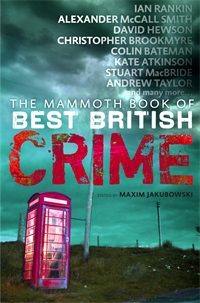
The Mammoth Book of Best British Mysteries 8, edited by Maxim Jakubowski

After quite some time, I'm finally finished with this anthology. This is not because it was a drag--quite the contrary. It's just that they don't call it 'mammoth' for nothing. And I don't really like to race through a short story collection.

I haven't been much of a mystery anthology reader in the past, nor had I really gotten all that tuned into mystery short stories. I'm not sure why, they just seemed abrupt in relation to the novels I usually read. But several people I know to one degree or another through the blogosphere actually had stories in this one, and I was more than eager to grab a copy. I am awfully glad I did.  In addition to the fine work of my virtual pals and acquaintances, Gerard Brennan, Paul D. Brazill, Declan Burke, Nigel Bird, and Jay Stringer, you've got bestseller types like Ian Rankin and Kate Atkinson, and many people who've work I know of but hadn't yet gotten a chance to read, like  David Hewson and Stephen Booth and and Christopher Brookmyre. And then known favorites like Colin Bateman and Simon Brett.

The scope of the book is vast--from cozy to seriously twisted (I'm looking at you, Mr. Brennan) and ranges from the historical to the contemporarily topical. One of my favorites of the book is the strange and initially disorienting 'As God Made Us', by A. L. Kennedy. Seriously, though, there isn't a rotten apple in the barrel.

One thing I did miss in this collection was any sort of contributor notes. The book does cite where the story was originally published and of course there's always the internet, but  after you read a story you like it's always nice to be able to look in back and find out a little bit more about who they are.

It's a quibble though. Pick up a copy of this fine volume and enjoy it at your leisure. You'll find great storytelling and a whole list of authors you want to read more of.