Friday, July 17, 2015

Disappeared by Anthony Quinn

Disappeared joins the ranks of other recent "post-Troubles" crime novels from Northern Ireland, especially in the Faulknerian 'The past is never dead. It's not even past'  sense. It's perhaps not entirely a coincidence that, as in Stuart Neville's novel Ghosts of Belfast, where one of the IRA's hard men is haunted by the victims of his brutality, this book opens with a wraithlike figure, wanting justice for the past. 

In this tale, though, it's retired Special Branch agent David Hughes who receives the visitation  on a stormy night. But as his mind is slowly coming apart due to Alzheimer's, neither he nor we can be sure exactly what the nature of this apparition is. Hughes takes up the case, but as this entails him vanishing from home, he also becomes the case of a police inspector recently returned to Northern Ireland from a long spell away in Glasgow. On top of this, he must investigate the brutal death of another man who seems to have led a quiet life, but may just have a hidden story. As Celcius Daly slowly realizes, these disparate circumstances may have more than a little to do with each other. 

Add to this the fact that there are people in high places who may not want some unpleasant truths revealed and, well, Inspector Daly may have his work cut out for him. 

There are a couple of reasons to read this book. The first is its thoughtful examination of how the past lives on in Northern Ireland and how people deal with their own roles in a violent era not far behind them. It's part of the growing discussion in Northern Irish crime fiction that wants to face this past more openly, including Neville's work and that of Adrian McKinty's Sean Duffy books, set in the Troubles era itself. 

Another reason, though, is for the descriptive power of the writing. Set mostly near the shores of  the giant Northern Irish Lough Neach, it's a dark and brooding setting, full of wind and water, and as Quinn points out more than once, the hidden little country lanes have seen more things than their quietness reveals.

My favorite image, though, comes from deep within the book. It doesn't have any particular spoilers and may convey to you some of Quinn's talent:

"In one of his dreams, he found himself stepping out through the back door of his cottage into pitch-darkness. The door gave onto the black wind. Voices whirled and echoed in the howling air. He realized his eyes were closed against the darkness. Opening them, he gradually made out a sky of dim stars. But the brightest thing in the night was a flowering thorn tree in the middle of a dark hedge. Its naked black branches were laden with white blossoms, shining like clusters of stars. A line of ghosts shuffled along the hedge toward the tree, as though it offered some form of protection. He saw Oliver Jordan climb up into the tree, then others, like stowaways boarding a boat, reaching up on their tiptoes, hugging the twisted branches while the blossoms stirred in the dark wind like a set of sails.
 
"...He saw the thorn tree gather them all up safely into its branches, ready to bear them off to a safer haven. But there was something anchoring the tree, something buried amid its roots, preventing it from carrying its cargo of lost souls heavenward. He gripped the gnarled base of the tree and tried to shake it loose, begging it to uproot itself, but it would not budge. The branches grated together as if in pain. He began digging with a tiny silver trowel, scratching at the stony soil."

It wouldn't hurt anything to tell you whose dream that is. But it strikes me that it could be the dream of any of these characters and represents their longings as well as his. As a matter of fact, it could just as well be the dream of the author himself.

Friday, July 10, 2015

Crystal Nights by Dorte Hummelshoj Jakobsen

I first came upon Dorte Hummelshoj Jakobsen's work through her blog, djskrimiblog. Dorte isn't as active in the reviewing world as she once was, having moved on to spending more time writing mysteries rather than reviewing them, but the archives are still there if you want to see what she was up to a couple of years ago. Although a large number of her reviews are in English and feature American and British books, being Danish herself she reviews Danish crime novels as well, sometimes in Danish if they don't have an English translation. 

It came as something of a surprise, then, to find that her first novel--at least the first one I'm aware of--was actually a very British cozy. As I wrote in my review at the time, this one is for fans of Midsomer Murders and others in the village mystery subgenre. 

Her next mystery was a very different kettle of fish. Anna Märklin's Family Chronicles shares some characteristics in common with the book under discussion here, as it has a historical element woven in with the contemporary. 

Crystal Nights begins in Berlin in 1938, on the infamous Krystallnacht, or "night of broken glass", when Nazi storm troopers and their sympathizers went on a rampage through many German and Austrian cities. The destruction and mayhem force the Stein family to flee the country. But tragedy finds them on their journey anyway. 

The story now jumps into the future, but a future that is already in our past. We are now in Kalum, a small Danish town, in 1967. Krystallnacht is now history, so much so that they are actually studying it in school. Neils Haugaard would rather be studying Kennedy's U.S. space program. He's also missing his friend Lars-Ole, who seems to be cutting school. 

But all is not well with Lars-Ole and in fact he's disappeared. We learn early on that, in fact, he's dead, but no one in Kalum knows that. Even his mother isn't aware that he's missing at first, and only gradually does anyone realize that he is not in any of the places he's assumed to be. More than one team of policemen will be baffled by this situation, and in many ways it takes the steadfast search of Lars-Ole's friend Neils to finally unravel this mystery. 

This was a very absorbing tale, even though we have a piece or two of information that the townfolk of Kalum don't have. For an American, the ways of a little Danish backwater are interesting just in and of themselves--for example, where the telephone exchange was in a little town like this. Watching Neils work his way through the possibilities of what happened to his friend is compelling (the police aren't bad, though maybe just a bit lazy), but what is perhaps most interesting to me is the way that Lars-Ole's spirit hovers over the book, so that you get to know him as well. He's not a ghostly presence or anything like that, but all the same it's true that it's really he and Neils working together who solve the case. 

I'll close with some notes I found about the Danish edition at GoodReads:


The Danish edition of the book, Krystalnætter, won a national competition in 2013. Judge and editor Lene Dalmejer explains her choice:

”Crystal Nights” is a highly commendable historical suspense novel that captures the reader from the opening phrase. It opens in Berlin in 1938 on the Night of the Broken Glass, and a Jewish family is preparing for a perilous escape to Scandinavia. Subsequently the story moves 30 years ahead to 1967, to the small town Kalum in Northern Jutland.
... and soon tales of destiny emerge, much larger than tiny Kalum. The novel is well-turned, and the plot is spot-on. Dorte Hummelshøj Jakobsen writes in a fashion that almost makes you forget you are reading. This is in itself a huge achievement. The language breathes freely, and we delve into the Denmark of the 1960s without any discord whatsoever. It is, in short, a first-rate novel!

Friday, July 3, 2015

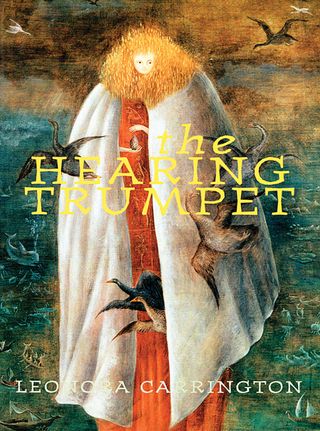
The Hearing Trumpet by Leonora Carrington up at Escape Into Life

I've just posted my review of the much beloved The Hearing Trumpet by the British born, Mexico based artist, writer and sculptor Leonora Carrington at EIL. It is quite a romp but something more than that too. There are some good links about her at the bottom of the review if you'd like to know more.

Tuesday, June 30, 2015

Ready for The Dubliners?

I posted this on our group's Finnegans Wake blog, but thought it might have a broader appeal...

This isn't strictly about the Wake, but if you are looking to deepen your context a little, I just learned that a book discussion of The Dubliners is starting tomorrow, July 1st, as a free online course from Berkeley. You can also spend a little money and get a certificate of completion if you're into that kind of thing. I've taken a few of these classes and it can be a little overwhelming, just because of the sheer number of participants, but on the other hand, invaluable. I haven't signed up yet, since it just came up, but from past experience, enrolling is quite simple.

Here's the link to the course. Maybe I'll see you there...


Friday, June 26, 2015

M.O. "Wishful Thinking" results and Flash Flood Fiction Day

(Reposted from Confessions of Ignorance)

Sorry to be straying so far off track here these days, but I thought I'd mention a couple of things that I actually know something about. The first is that the results of the M.O. Wishful Thinking contest have come in, and though I didn't win I still enjoyed the process and am glad I took part. I'll post a link to the winning story here I think on the 10th, but if I get sidetracked you can always check in over there.

Meanwhile, though, a friend happened to mention the Flash Flood Fiction Day coming up on Saturday (tomorrow) at Flash Flood Journal, and I somehow managed to write something up quick and get it in in time to be published there. They tell me it ought to be up at about 2 PM British Summer Time (BST) or 6AM California time, as near as I can reckon. So look for "The Rival", or just check out the website and see what everyone's come up with. I know that's what I'll be doing. The maximum word count is 500 words, so these will be short pieces for your delectation.

Kids, don't try this at home.

Saturday, June 20, 2015

Riccarton Junction by Scott Beaven


Riccarton JunctionRiccarton Junction by Scott Beaven
My rating: 4 of 5 stars

A strange and mesmerizing tale. Told from the point of view of a teenager on the verge of adulthood, it covers a lot of ground. Our narrator, Kikarin, is the daughter of a Japanese mother and a British father, and thinks of herself as British but knows that her exotic appearance sets her apart. Even in the London district of Putney her friends tend to be outsiders, but now she's spending her last year before university in the remote Scottish Borders area, where she finds that she's basically incomprehensible to many of her classmates. This doesn't stop seemingly every male in the area from being attracted to her, and not always in the most gentlemanly ways. Though it comes in conflict with taking her all important placement finals, she's called upon by her mother to accompany her as she gets Kikarin's brother out of a youth detention center for a weekend parole.

I liked Kikarin's voice a lot. Although a lot of the events in the book happen to her, there is an observational tone to her telling, as she tries to sort out her various relationships. I thought her parents flashed a bit hot and cold on her, and when she suggests at one point that they are buying a dog to replace her as she goes off to college, it doesn't seem so far-fetched. For much of the story, they seem to be preoccupied elsewhere, sometimes with good reason, sometimes not.

Despite the loutishness of many of the locals, the setting itself is one of the strengths of this book. Kikarin has an archeological interest which takes her to places like an abandoned railway station and an historic castle, and the site of some prehistoric cup and ring marks.The almost haunted feeling in this often empty landscape will stay with me for a long time to come.

View all my reviews

Wednesday, June 17, 2015

Concrete Angel by Patricia Abbott

Although Concrete Angel is Patricia Abbott's debut novel, the term debut may be a little misleading. She has scores of short stories published both on line and in print, some of which appear in group anthologies, and some in anthologies of her own. She has won the Derringer Award, which honors excellence in short mystery fiction. And if you're wondering if there is any connection between her and the Edgar award-winning author Megan Abbott, there is. Megan is her daughter.

It's an interesting coincidence, then, though presumably not in any sense autobiographical, that Concrete Angel proves to be a mother daughter tale to the nth enmeshed degree. Although there are crimes galore in this book, the most significant one happens in the opening pages, when Eve Moran shoots a man in her apartment whom she has only known for a few hours while her daughter lies sleeping in a room next door. Guess who winds up taking the fall for it?

Although certainly qualifying as crime fiction, this novel is really a sustained study of the larger than life personality of Eve, born  Evelyn, by a witness with unrelenting focus--her daughter Christine. In this it reminded me of the short story collection by Natalie Serber, Shout Her Lovely Name, which describes a similar (though not criminal) mother daughter relationship in a series of linked tales. As in that book, there is an episodic, picaresque quality to this tale, as many other characters float through their lives--mostly men. But Eve and Christine are the earth and moon of this story, although Christine's father and grandmother exert their own gravitational influences. Mostly, though, they just manage to keep the pair afloat. This is a dyad that needs a lot of buoying up--cash infusions, temporary and not so temporary lodging, babysitting arrangements.

One of the narrative techniques I was impressed by in this story was Abbott's ability to switch point of view seamlessly when she needs to tell a part of the story Christine would not have been present for. Although I may be wrong, it seems to me that the way she achieves this is to have Christine switch in these sections from the first person to a third person perspective, which signals that she is telling the story from things she's put together later. It's quite effective, because it allows Abbott to tell the story from a child's point of view as well as an adult's.

The story is set in the region around Philadelphia in the seventies, though moves back in time to earlier eras in Eve's life. It's a time period that I'm familiar with and Abbott gets the details of this era right--more so, I think than, say, Mad Men, which tends to glamorize and romanticize its slightly earlier  period without quite nailing it. The blood red Ericafon with its dial underneath its base, is not only iconic of the period but plays a crucial part in the downfall of Eve's victim, the unlamented Jerry Santini. And the background television of shows like the Mary Tyler Moore Show and Bob Newhart were indeed what most families were tuned into on predictable nights at predictable times, even, it seems, highly dysfunctional families like this one.


An interesting interview as well as more about the book can be found in J. Kingston Pierce's piece for the Kirkus Review.